

John Russell Fearn’s The Five Matchboxes does a lot of things rather well, but what’s missing from the book are the things that move me from admiration to adoration. You see, TFM is a procedural, a subgenre of mystery fiction that emphasizes the realistic depiction of law enforcement methods and processes in solving a crime. My problem with procedurals is that they rarely raise the stakes with a second murder (always nice) and they rarely compound the original problem. What you get at the start is what will be eventually hashed out. The problem/impossibility/mystery doesn’t compound. Why not?
Usually because the book is too busy tracing the detective’s path.
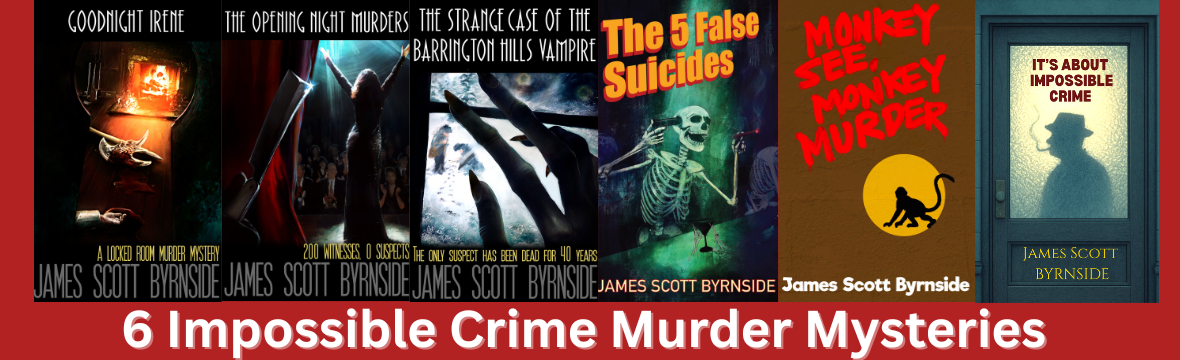
In my books (and the books I love to read), this is never the case. In Monkey See, Monkey Murder, I present the problem of a monkey targeting a specific individual. Do I leave it at that and slowly let the detectives figure it out? Fuck no! I add a locked-room murder/dismemberment with another monkey on the scene. In Vampire, do I leave the no-footprints problem as the readers only nourishment? I would never do that in a novel! Another locked-room murder is in store.
If there’s only one impossibility, that’s fine, but at least give me the threat of another murder. Let the fear flow through the entire novel. In TFM, we get an impossible murder (a damn good one) filled with strange little clues/details that pull us in. And then…
The terror is over. No one else is going to get killed. There’s no need. What a shame. Secondary murder motives are great fun. Sometimes it’s to hide the crime, sometimes it comes from a second plot — whatever the reason, they serve to destabilize the reader. Ever time you think you’ve got a footing, BAM — you get knocked on your ass again. That character who promised to blow things wide open has been offed.
The majority of TFM (post murder) is pure investigation. It’s interesting, ingenious and (unfortunately) safe.
I don’t wish to sound negative. In many ways, I consider John Russell Fearn to be my spirit animal.
The Plot: Detective Inspector Garth receives a troubling note, informing him that stockbroker Granville Collins will be murdered between 9:00 and 9:30. Garth cannot believe it, but a trip to Collins’s office proves the note’s validity. Collins was shot in his office between 9:00 and 9:30. No one else was inside and the windows were shut and intact. The shooter was about fifteen feet away. It was (dun dun dun) impossible. The killer left a calling card too. Five empty matchboxes with small holes drilled in the bottoms.
The Investigation: Fearn loves showing off his knowledge here the same way he did in Pattern of Murder and (just like that terrific book) there is technology having to do with sound. There’s a ton about fingerprints and the analytics of typing. Some of it’s great. There’s just…too much. I could have done with some rudimentary snooping here and there. When Garth does make a leap-of-faith deduction it seems out of character. Because there’s no second murder/impossibility the investigation drags at times. The revelations have to be doled out far too judiciously, making none of them awe-inspiring. Check out something like The Judas Window to see how this sort of thing should be done. The solution to the matchboxes comes at halfway through the novel (exactly 50% according to my kindle) and it is curiously unimportant. I’m not against misdirecting the audience, but it’s indicative of the way the book’s revelations do little to excite the reader.
The Solution: It’s good, a bit old fashioned perhaps, but a clear example of how principles can be spun in so many different ways. I’ve seen this principle used several times, but Fearn has an adventurous spirit and gives us a new look at it. As Garth tells a doctor,“Thanks, doc — you know your job. But it doesn’t pay sometimes to be too hidebound. Imagination helps, you know”
And there’s one other thing he does that’s quite funny. Well, it was funny to me as an author. Sometimes we go so far off the deep end in regards to method that it requires us to add a detailed explanation/excuse/defense for our outrageousness. Fearn uses three (!) pages of historical examples to prove the soundness of his method. I cracked up when I read it. Some of you might be angry, but not me. I empathized completely.

 James Scott Byrnside
I have bought this, I had read it…I have not reviewed it, and I remember nothing about it. Perhaps a revisit is on the cards…
LikeLike
I’m not sure this deserves a reread. I’d compare Fearn to Walter Masterman, Brian Flynn, or Van Wyck Mason in that he’s competent and brimming with good ideas, but he doesn’t quite offer the mixture of murder and madness that I crave. You (of all people) know what I’m talking about. I’d say the most attractive things about Fearn are his pulp sensibilities (Pattern of Murder has shades of Thompson and Brown) and his crazy murder methods/outcomes. I’m going to read more before I make any declaration about him.
As for your foggy memory, it could indeed be a sign that this offered nothing of interest to you. As i said, the investigation drags a bit. There are two people the detective interviews on three (!) separate occasions. There ought to be a law against such a thing! Maybe the detective has to interview someone a second time, but three? No way.
LikeLike
I read this maybe 5 years ago. Random inconsequential scenes still kick around in my memory, but I don’t recall the solution at all. I still have yet to read anything impressive by Fearn.
LikeLike
I’d recommend Pattern of Murder.
LikeLiked by 1 person