One of the best things about writing a short story collection is that the process naturally lends itself to editing. Let me explain.
Many writers finish a draft, set it aside, and move on to something else. When they return to it a month (or more) later, they come back with fresh eyes. They can see the piece free from the biases of creation — and trust me, you’d be surprised how many half-formed ideas manage to linger in a story still in utero. With time and distance, the story’s true rhythm starts to reveal itself.
Alas, I’ve never been able to do this. I work on one thing at a time. It consumes me. It’s all I think about. Only when the project is fully excised (read: published) can I decompress, forget everything I know about writing, and stumble into the next idea.
But not this time.
Writing an anthology has offered me a natural cure. As soon as I finished one story, I moved directly into writing the next. When I eventually returned to the earlier story — often two months later — editing became not only possible but surprisingly painless. The distance had been built into the process.
Here’s how that played out.
Silent Steps of Murder — When this story was written, I had vague ideas of using an overarching narrative. This idea was nixed early on because it was far too much work. There was still a lot of set-up for that overarching narrative when I went back to edit. I had to get rid of any mention of it. I also changed a sequence so that we follow Rowan’s actions instead of Walter and another character watching them. This made one clue far more apparent that it had been. I also cut off the ending at a point that made sense with the style of the story.
Where There’s Smoke, There’s Pazuzu — I cleaned up the reveal. Despite the wild events that open this story, the ending was always why I wrote it. That ending needed to flow crystal clear. For character and for making the revelations satisfying, I spent a lot of time on those last few pages.
Instrument of Death — This required very little work. I mostly cleaned up actions and description.
The Preminger Curse — This story got the least amount of editing, but it had the tremendous benefit of a live read-through. A friend of mine came to visit and we read the story aloud. It was quite satisfying to find that the problems were minor — mostly at the level of word choice. This story has more characters than the others. I was pleased as punch to find that character voice was not an issue. I was worried two of them might sound the same.
Cue, Murder! — Two clues were supremely unsatisfying. I altered their presentation significantly. This is a sister story to the first one in that they are so narratively straightforward. This one in particular offers a few things that my regular readers may not appreciate as much as the others. But you never know.
And last night, in the haze of completion, I had a meeting with my cover designer. We had already messaged back and forth. The idea is not to use an image that matches one of the stories, but rather (as Matt put it) to make an album cover for my detectives. He fancied the idea of their business card. I liked it, but there ended up being too much text on the image.
I also liked the idea of their office door. So that’s the direction we’re going. I sent him a couple of quickly-thrown-together images.
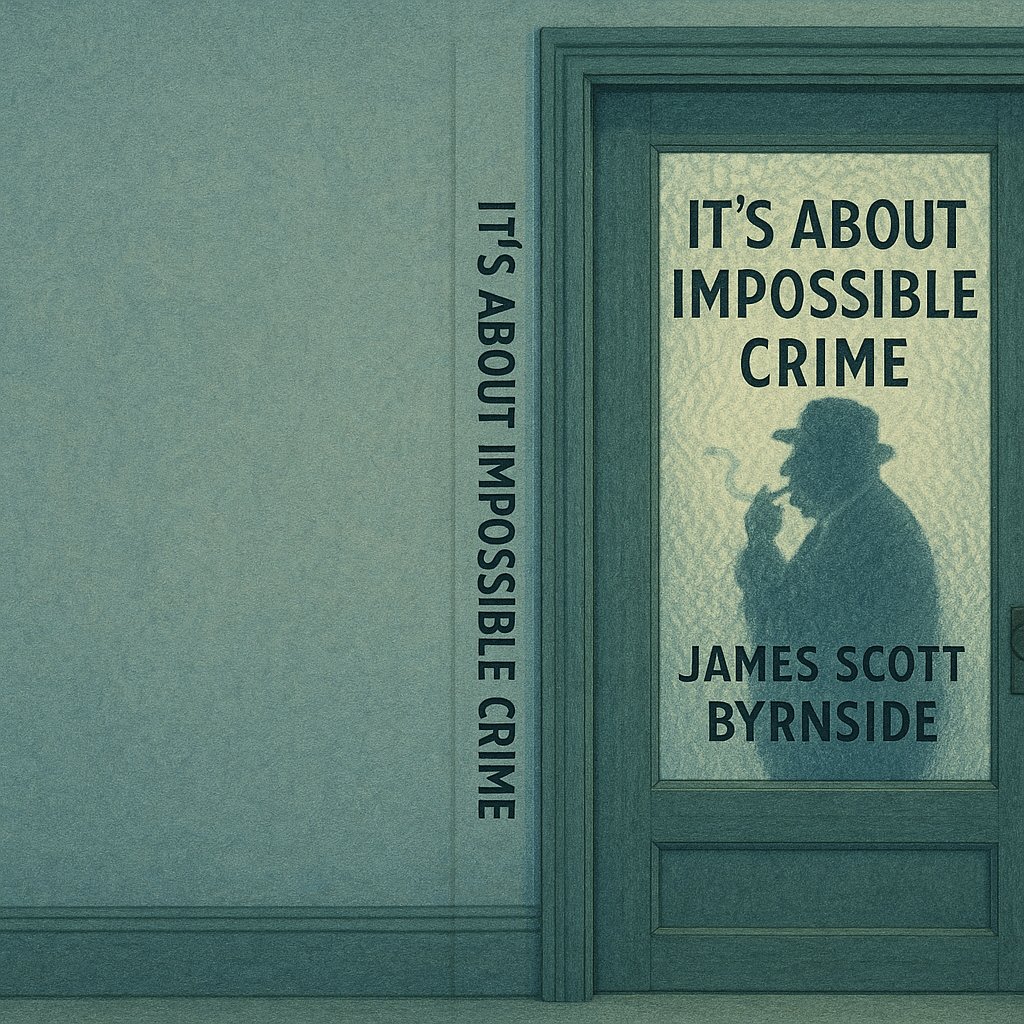
I like these greens. The back will be a wraparound–in this case, a continuation of the hallway. Maybe Matt can fit in a window. We’ll see. The one thing he didn’t like was my name over the frosted glass.
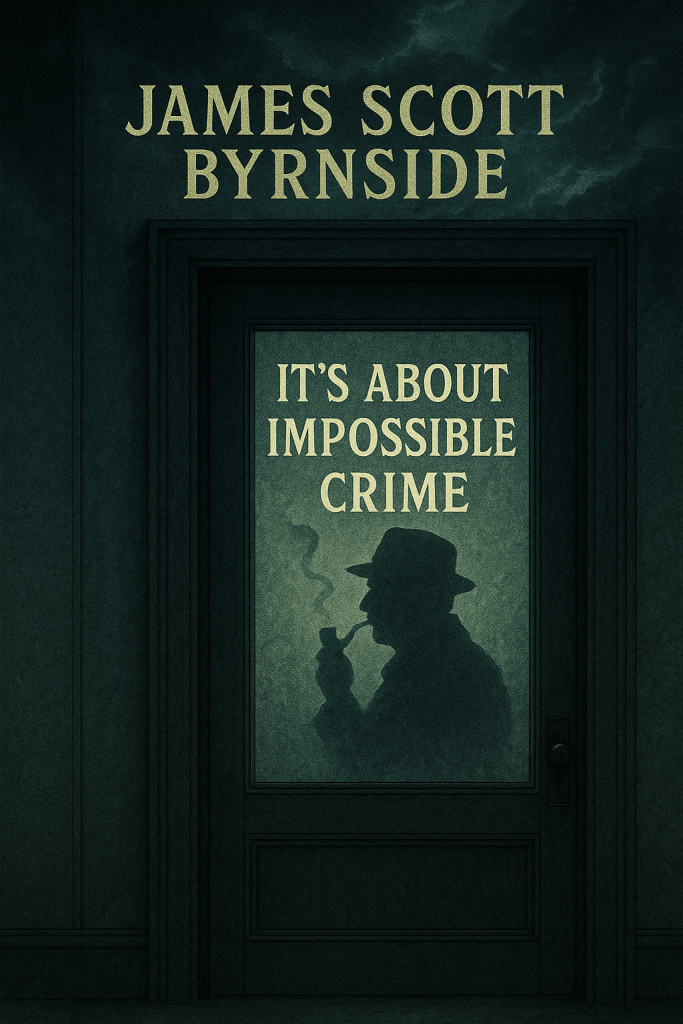
It’s just a prototype, but this is the idea.
So, now I wait on Matt. Maybe a week. Maybe two. We shall see. After that, I’ll order an author’s copy. I will post it here as soon as it arrives. I’ll read it and check for any final issues. And then this project will be finished and I will announce the publication date.
It’s been a long time coming.
Thank you for your support, your readership, and…your money. It’s actually your money I’m most interested in. Behind your back, I don’t call you a reader. I call you “The money”. And when you don’t buy a book, the names I call you are much, much worse.
Hope all is well.

 James Scott Byrnside