I recently read Boris Akunin’s Murder on the Leviathan. It’s as good an Agatha Christie pastiche as you’re likely to find: a closed-circle mystery with an international cast, full of elegant clues, class tensions, and the familiar contrast between social decorum and violence. Akunin writes in lucid, accessible prose that keeps the narrative crystal clear.
It was fine. Not great, not bad. Just fine.
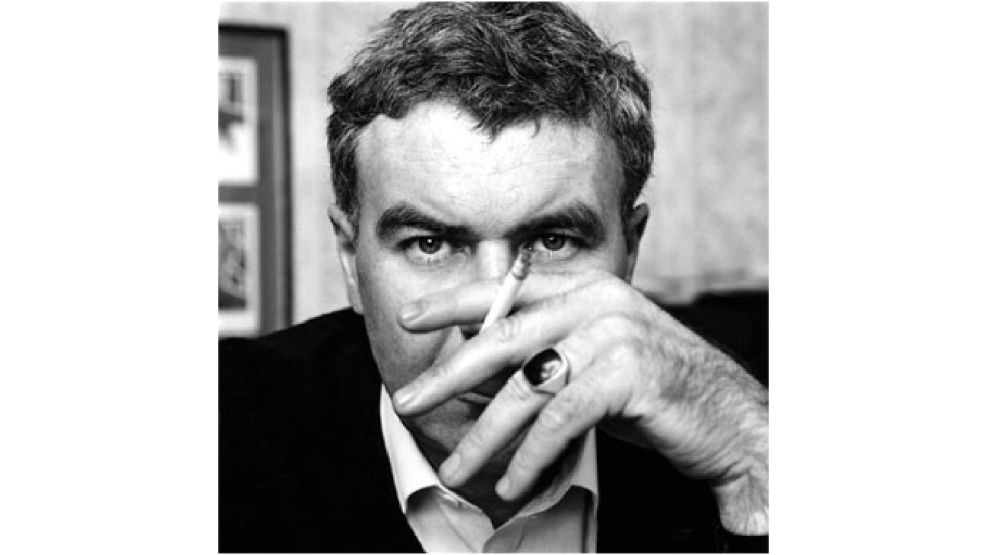
I also reread Raymond Carver’s short story Cathedral. I first read it as a teenager and didn’t rank it among his best. But age has made me appreciate it far more. One of my ESL students enjoys discussing literature, so I’ve shaped our lessons around authors—one week, he chooses (Hemingway, Fitzgerald, Fleming), and the next, I do (Flannery O’Connor, Cormac McCarthy, and now Carver).
It’s been good for my writing—reading outside my genre. O’Connor and Carver, in particular, have sharpened my short story instincts. With Carver, I’ve found the opposite of Fitzgerald. Fitzgerald wrote about grand, mythical worlds, with disillusionment as the central theme. Life turns out not to be all that and a bag of fries. That tracks with Fitzgerald’s life.
Carver, on the other hand, wrote about moments of clarity breaking through the fog. His world is small—just a pinprick at the edge of a suburban trailer park—but his stories build toward something radiant. A drunken, broken man sees something clearly. A moment of grace sneaks in.
I first encountered Carver as a teenager, through Robert Altman’s Short Cuts, a film mosaic adapted from several Carver stories. None of my friends wanted to see it, so I went alone — this was typical. It was a year after The Player had brought Altman back into the spotlight, and I was entranced. The film was quite an experience for 17 year old me. I bought all of Carver’s stories soon after and loved them just as much.
Now I realize what the movie missed. I still love Short Cuts, but it lacks those crucial Carver moments—those flashes of lucidity. His short stories are quiet revelations.
In the late ’70s, Carver’s doctor told him he would die if he didn’t stop drinking. So he stopped. Ten years later, lung cancer got him. But during those years, he found sobriety, love, work, and peace. He wrote a poem about that time. It’s called Gravy.
No other word will do. For that’s what it was.
Gravy.
Gravy, these past ten years.
Alive, sober, working, loving, and
being loved by a good woman. Eleven years
ago he was told he had six months to live
at the rate he was going. And he was going
nowhere but down. So he changed his ways
somehow. He quit drinking! And the rest?
After that it was all gravy, every minute
of it, up to and including when he was told about,
well, some things that were breaking down and
building up inside his head. “Don’t weep for me,”
he said to his friends. “I’m a lucky man.
I’ve had ten years longer than I or anyone
expected. Pure Gravy. And don’t forget it.
Anyway, that’s what I’ve been thinking about lately. I’m still working on the automaton story, though I’ve been spending as much time on theme as on the trick. I’m not sure a locked-room mystery can deliver a moment of visionary lucidity—but I’m trying. I’ve restarted the plot several times—rearranged the tone, changed the point of entry. I’ll take my time, the same way I did with the first volume.
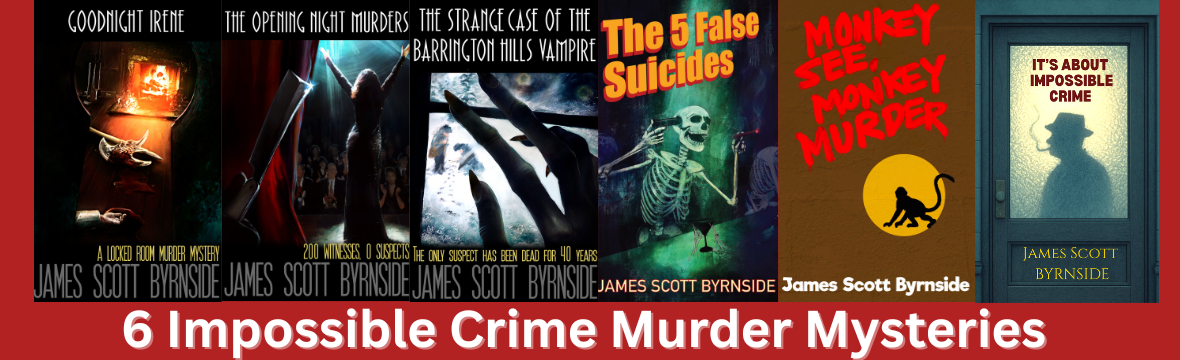
Oh, and yes—this one might be It’s About Impossible Crime, Vol. II. We’ll see.
Take care. Keep doing what makes you happy. And if you want to hear Cathedral, James Naughton does a great job HERE.

 James Scott Byrnside
I read Leviathan many, many years ago.
And Akunin’s other books, too.
I love Fandorin. And Mike Hammer Spillane-Collins.
And now I’m reading one of the late John Creasy’s works. This is someone to be proud of, more than half a thousand books published by the comrade during his life.
LikeLiked by 1 person