The old Visitor House crouched at the edge of the woods like something half-forgotten. Cloudy windows, rafters lost in shadow, and brittle November light that died a few feet past the threshold gave the place the air of abandonment. It smelled faintly of dust and cold stone—an emptiness that made every footstep sound too loud. In that dim, lonely chamber, the five of them stood, their breath a faint frost.
Bradley Friedman moved among his guests with a tray of brandy glasses. “I’m grateful you could join me,” he said, his cheer threaded with nervous energy. “Tonight is only a test, but if all goes well, I’ll present the full act come spring. Think of yourselves not as guinea pigs—no, no, I like animals far too much—but as brave pilgrims on my little maiden voyage into magic.”
“Magic, eh?” Mayor Edgar Lamm downed his brandy and swiped his walrus mustache clean. “I thought you were a thespian.”
“I’ve always had problems with commitment. You know that, my dear Edgar.”
He snickered. “You’ve been very secretive, Friedman. The payoff better justify the curtain-raising. I hope I haven’t been dragged out to the woods for a common rabbit pulled from a top hat or a…or a card in a sleeve.”
“Perish the thought. I invited you because you’re the elected head of Red River. My trick is so spectacular that you deserved to be among the first to witness it.”
“And me?” Sheriff Amos Birch asked. “I’m not likely to be impressed even if you sawed a woman in half.”
“That’s simple. You’re the most skeptical man I’ve ever met—a man allergic to bunkum. That’s the sort of man I need. If I can make you believe, the rest of the town will be a cakewalk.”
Amos’s weathered face bent into something close to a smile. Lean, angular, flintlike—he seemingly embodied skepticism. “I never thought I’d say this, but…guilty as charged, Friedman.”
Bradley turned his attention to the two female guests. “That leaves us with Annie Dawson and Marla Stapleton. You are both teachers at the Oldham School. I love teachers almost as much as I love theatre, and my ties to the school are strong, but that is not the reason I invited either of you.”
Marla licked the brandy off her buck teeth. “I know why you brought me.” She snorted and reached into a bag. “My uncle is a cobbler and you asked me to have these made for you. Though I can’t imagine why?” She pulled out a pair of Congress Gaitors.
He took the shoes from her and flipped them over. “Oh, isn’t that lovely.”
The soles were cut in a neat field of diamond treads—except for the center one, which was turned at a precise forty-five degrees.
Mayor Lamm harumphed. “Silliest thing I’ve seen in some time. Why would you have shoes like that made?”
“Because no one else in the world has them.” Bradley grinned. I needed something unique that had no equal in the world.”
“I don’t follow.”
“My dear, Edgar, you will soon enough.”
“And me?” Annie Dawson’s voice was meek, ironically grabbing everyone’s attention due to its lack of authority. She had a mane of rich, chestnut hair, but her hazel eyes were dull, incapable of piercing. She was also the only member of the group who abstained from drink. “Why am I here?”
Bradley regarded her as if she were a rare book newly opened. “You, Miss Dawson, are the most important person present.”
Her cheeks tinted. “You’re not planning to embarrass me, are you?”
“Goodness, no.” He slipped an arm gently behind her shoulders, guiding her forward. “You’ve been in Red River just one month, and I recently learned that you have never heard the town’s most infamous story.”
The others exchanged looks of apprehension.
“No one’s told you?” Marla asked.
Amos shrugged. “No one cares. Been fifty years. There’s no reason to tell everyone who moves here about it.”
“Fifty years since what?” Annie asked, though she felt a faint cold of anticipation.
The lines in Bradley’s face rearranged themselves into a conspirator’s smile as he drifted toward the nearest lamp, letting its glow paint half his features and leave the rest in shadow. He allowed the silence to stretch one heartbeat longer before beginning.
“Since the only recorded murder in Red River.”
Edgar grinned into his drink. “You are quite the showman, Bradley Friedman.”
Bradley rubbed his hands together. His voice dropped into a tone he clearly relished. “This town has always called itself God-fearing. But around here, that never meant reverent. It meant frightened. The church has ruled Red River longer than any mayor, any railroad man, any school board.”
He tilted his head toward Annie.
“Have you had the displeasure of meeting Reverend Cyril Maddox yet?”
Annie shook her head.
Amos nodded. “Count your blessings.”
Bradley smiled thinly. “Yes… he’s rigid. But if you want unyielding, you should’ve met his grandfather, Theodore Maddox—pastor, patriarch, and in 1872, when justice needed a hand…” He caressed his throat. “Hangman.”
Annie’s eyebrows rose. Bradley accepted this reaction as his due.
“Now,” he said, “into this pious little kingdom wandered Ambrose Kellach. Magician. Visionary. A man who could make a roomful of sensible farmers doubt the very ground they stood on. He performed in our theater—what is now my theater—and each night someone walked out swearing he consorted with spirits. Some even said with the Devil himself.”
He leaned in slightly, conspiratorially. “I’ve read the old notices. They never called him talented. They said he was unnatural.”
“But the real scandal,” Bradley continued, “wasn’t his magic. It was Sandy Benton. Seventeen. Bright as a struck match. She should’ve graduated that spring, but instead she ran off with him as his assistant, and soon enough as his sweetheart. They toured the Midwest, and for once the stories were true: they prospered. Came back three years later with fame, a polished act… and a child. A boy. Their boy.”
Annie’s breath caught. “A child?”
Bradley nodded. “Yes. And for that homecoming show, the whole town squeezed itself into the theater. They wanted wonders—and they got one, though not the sort anyone hoped for.”
“What happened?”
“Sandy Benton fell,” Bradley whistled an imaginary drop from the ceiling. “Plummeted from the rafters. And here’s the part that chilled the crowd: she didn’t scream. Not a sound. When the doctor reached her, he saw why.”
Marla, unable to help herself, murmured, “She’d been strangled.”
“Exactly.” Bradley’s voice softened. “Ambrose swore he was innocent. Begged them to let him explain. But reason had already fled. They’d seen this magician accomplish the impossible. Why wouldn’t he be able to make a dead woman fall from the sky. Reverend Maddox declared the Devil had claimed his due, and that was enough. They turned from audience to executioners in the space of a breath. They beat Ambrose until his limbs hung wrong. Dragged him north—to the river, to the old icehouse. And there, in that barren field where nothing grows quite right even now… they hung him from the lone tree that ever managed to survive out there. They let his broken body sway in the wind for three days. Then they buried him in an unmarked grave.”
He raised his glass, letting the firelight wink off the rim.
“And that, Miss Dawson, is the story of the only murder in Red River.” He offered her a small, knowing smile—the smile of a man about to show his guests a trick. “But stories like this—violence, love, fear, superstition—those don’t stay quiet. Not when pieces of Ambrose Kellach’s life have begun surfacing again among the living.”
Marla poured herself another brandy. “What do you mean by that?”
“This past summer, I found a trunk in the attic of the theatre. Inside was a treasure trove of items from Mr. Kellach, including correspondence, a diary, and notes of his tricks. Many of these items were encoded. However, I have friend in Carbondale who was a cryptographer for the Army. He’s been helping me to decipher the documents. The first one we did was tonight’s trick.”
At last, Annie breathed easily. “That’s all?”
“A lost trick of Ambrose Kellach is nothing to sneeze at, I can assure you.”
“Let’s see it,” demanded Amos. “My wife is expecting me home for dinner.”
“For that we have to go out back.”
“To the Folly House?”
“That’s right.” Bradley motioned to the back door. “Come.”
It was a muted November dusk, the kind of light where edges blur and colors fade into the same tired grey muddle. Across the stone walkway, stood their destination.
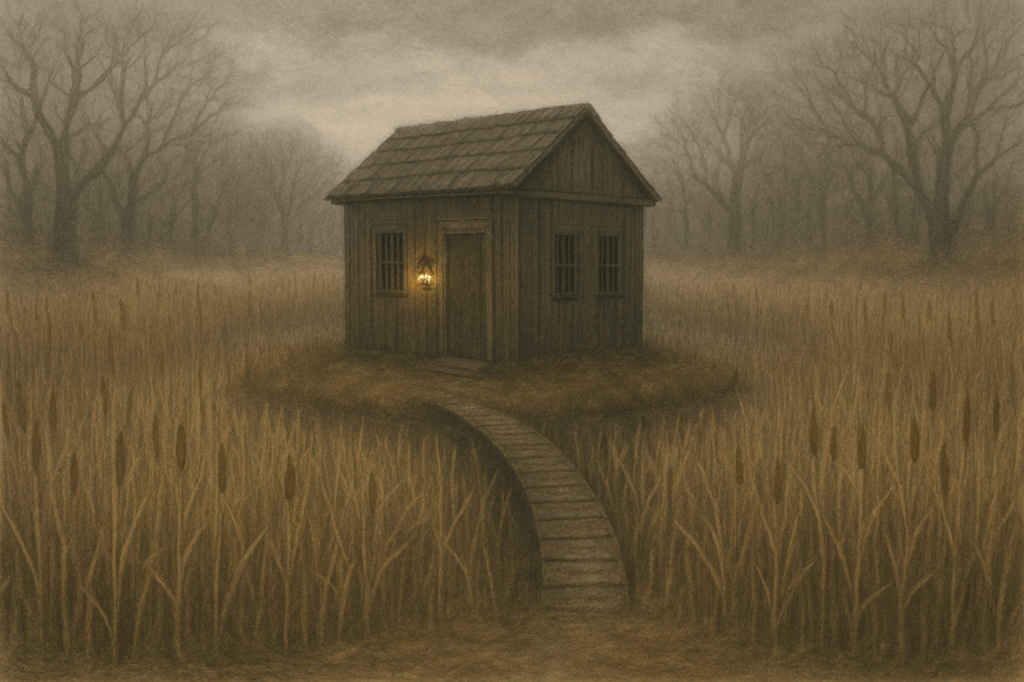
At first glance, the structure looked like a small, square house stranded on an island. It stood only a single story tall but was sturdily built, boards weathered to the gray of driftwood. A single lantern—lit for the occasion—hung by the door, throwing a teardrop of gold against the wood. The windows were narrow, old-fashioned, framed in black iron that had long since rusted.
Surrounding it on all four sides was the moat: ten feet wide, a ring of water gone stagnant, patchy with mats of dull green and black. The water was shallow now, in some places little more than a skin reflecting the sky. Throughout the water stood reeds—pale, brittle cattails, their stalks hollow and fragile yet still upright even in November.
A narrow wooden footbridge arched from the near bank to the shed-house. It was the single point of access. At the bridge’s far end, the door of the Folly House sat square and dark—closed, latched, and visible to all.
Behind it stretched a thinning belt of woods—mostly bare oak and sycamore—whose skeleton branches rattled quietly with the slightest breeze. The forest floor was carpeted with dead leaves, a muted copper.
Even in the dying light, Annie sensed the density of it, the silence, the way sound seemed swallowed whole. “It’s really quite…something. What is it used for?”
Edgar Lamm answered her. “This area used to be a nature preserve. The Folly House was used to store supplies. It was open to anyone who pledged to work the grounds, planting or trimming. At some point, the town lost interest in the upkeep. Occasionally it comes up in town meetings, but there are always more pressing matters to deal with. It appears as if someone has taken it upon himself to clean it.”
“That would be me,” said Bradley. “I hope you don’t mind, but I wanted to make it presentable for this evening.”
The lantern by the door flickered as if something inside had breathed.
Marla shivered. “Let’s get on with it, Bradley. It’s getting cold.”
“Of course.” He spoke as he crossed the footbridge into the Folly House. “Unfortunately, Ambrose didn’t say anything in his diary about how he planned to present this trick. The only thing he wrote was the principle.”
“Do you mean, Mr. Oldham?” asked Annie.
Bradley laughed. “No, not the principal of the school. The principle of the trick. I immediately thought of using the Folly House because of its unique construction.” He returned on the bridge with a bag of hydrated lime and a rake. He proceeded to cover the footbridge with the lime and then carefully rake it into a smooth layer on the bridge as he crossed back onto the lawn. A small amount of lime spilled into the water, but most of it remained on the bridge as a flat surface.
“As you can see, the footbridge has no raised edges and its surface has been covered with lime.” He set down the rake and the bag of lime onto the grass before removing his shoes and putting on the pair with the special soles. “We have also firmly established that these shoes, or at least their treads are one of a kind and cannot have been reproduced. Watch.” He slowly crossed the bridge, taking slow, heavy steps and leaving perfectly-etched footprints of the diamond-patterned soles. When he reached the Folly House, a set of perfectly preserved prints showed in the lime. In each one, the wood of the bridge was visible. He took off the shoes and wiped them clean.
“Now, I will ask all of you to have a close look at the plant life in the moat. You’ll notice that the reeds are brittle and high. If I tried to escape this structure via the moat, even with stilts, I would crush the stalks and leave evidence.”
They walked around the moat. Everyone agreed with his logic.
“And if I attempted to leave via the bridge, I would leave new tracks in the lime.”
“Agreed,” said Amos.
“And the Mayor can attest that there are no secret passages inside the Folly House.”
“Not unless you’re created them.”
Bradley laughed. “I have not.”
“So, what’s the trick?”
“You will go inside and wait for 10 minutes. When you return I will be standing on the lawn and neither the reeds nor the lime will be molested.”
“Why 10 minutes?”
“Because when I tested the trick earlier, it took me eight-and-a-half.”
Annie saw the flaw immediately. “But that’s no trick at all. It’s simple. You’ll walk across the bridge and take the rake. As you return to the Folly House, you’ll pave the lime smooth. Then, you’ll simply walk backwards onto the lawn.”
“I’m afraid that will be quite impossible, Miss Dawson.”
“And why is that?”
“Because I will place these shoes on the table in the back of the Folly House. There will be no way for me to leave with them.”
Marla gasped. “I see now. It will be impossible for you to recreate the marks in the lime. You didn’t know the shapes my uncle would use.”
“That’s right. I specifically told you to surprise me. I cannot cross this bridge without disturbing the lime or the plants and I cannot cross the moat without disturbing the reeds. And yet, I will escape this prison somehow. Now, go inside and come up with some ideas of how it can be done. You have ten minutes. Go, go.”
They did as they were told, reconvening in the Visitor House.
Edgar came up with the first theory. “He needs ten minutes. That means there must be some jiggery-pokery with the lime. He’ll reset it somehow.”
“Can lime harden?” asked Marla.
Amos scoffed. “Not in ten minutes. I think Annie had it correct. He’s gonna repave the bridge and walk out backwards.”
Annie’s forehead crinkled. “What about the shoes? He said they would be on the table in the back room. He can’t walk out in them.”
“That must be the trick. He’s going to replace them from outside.” He took a sip of brandy. “Somehow.”
Edgar stroked his considerable mustache. “How would he get the shoes into the back room of the Folly House from across the bridge. Maybe a wire trick or…or a trained bird.”
That last comment drew three incredulous stares.
“I read it in a mystery novel. Birds are easily trainable.”
Marla shook her head. “He’s never said anything about working with birds before.”
“Yeah,” said Amos. “Let’s keep the solutions realistic.” He checked his pocket watch. “We have about seven minutes left.”
Annie opened her mouth to speak, but thought better of it.
“Say it, Miss Dawson. We’re open to any ideas.”
“Well, I was going to say that he could climb on the roof and lay a long pole or a ladder so it led to the lawn. But, he’s not the acrobatic type.”
Amos laughed. “If he tried that, he’d fall and break his neck. We’ll find him out there, dead on the bridge.”
“That’s not funny, Amos.” Marla cast a disapproving glare his way. “Finding Bradley Friedman dead.”
“I can laugh because it isn’t going to happen. And there’s no way Bradley is out there balancing his old ass on a pole.”
They continued to hypothesize possible solutions, but none felt satisfactory.
With a minute left, Edgar waived the figurative white flag. “I told you that I read these mystery yarns from time to time. In some of those books, there have been so-called footprint problems. The solution always has to do with timing or walking backwards or some type of acrobatic maneuver or carrying someone else. But the parameters of Bradley’s trick seem to exclude all those. I’d have to guess that it has a solution I’ve never before encountered. That makes sense. Ambrose Kellach, for all his evil deeds, was supposed to be a fine magician.” He checked his watch. “Well, time is up. Let’s see if he’s done it.”
It was quiet outside. The rusty yellow of early evening had almost given way to darkness. Nothing about the Folly House appeared different. The footsteps were still on the bridge, and the lime’s surface remained smooth. Bradley Friedman was nowhere to be seen.
“Well,” said Amos. “Where is the magician?” He called out. “Bradley?”
Silence.
An unease took over them. Bradley was supposed to be standing outside, mocking them playfully with his sudden appearance.
The mayor, as was his usual want, took charge. “I suppose we’d better check the moat and get a close look at the prints. Perhaps, he’s waiting for that before he appears.”
This yielded nothing. The vegetation remained unbroken and the diamond-embossed footprints undisturbed.
Edgar called out. “All right, Friedman. You win. Come out and tell us how you did it.”
Marla shivered. “I’m getting cold again.”
“Hell, enough of this.” Amos walked over the lime, mixing his own footprints with Bradley’s as the powder crunched under his heavy steps. “I don’t know what you’re up to, but it’s becoming tiresome.” He opened the door.
His breath stopped short, as if his chest had struck something solid. For a moment he only stared, eyes fixed and unblinking, his broad frame locked in the doorway like a beam wedged too tightly to move.
Amos took one heavy step forward and then stopped again. A low sound escaped him, not quite a word, not quite a curse. A helpless breath.
The others began to follow, but Amos help up calloused palm at the women.
“Don’t!”
His eyes met Edgar’s. “Have a look, Mayor.”
Edgar shuffled over the lime. “What is it?” He stopped at the threshold. “God in heaven.”
Bradley Friedman’s body lay sprawled on the rickety floor of the Folly House, his throat cut cleanly, the wound dragging his features into an expression of stunned incomprehension.
In life, Bradley had been all brightness—quick wit, easy laughter, a man who treated everyone as though the world were a game worth playing. Even weeks later, townspeople would still find themselves recalling his warmth, his harmless tricks, his absence of bitterness. That frozen mask of horror belonged to someone else entirely.
And that was one of the questions that would not leave the people of Red River for some time: who could hate a man like that enough to kill him, and why take such savage care in the doing?
Behind the ghastly corpse, at the back table, sat the shoes with diamond-shaped soles—the only ones that could possibly have made those prints on the bridge—just where Bradley had promised they would be.
And then Edgar asked the other question that would stump everyone in the days to come.
“How?”

 James Scott Byrnside