
Philip MacDonald’s Mystery at Friar’s Pardon opens with a careful introduction to the man who will become our amateur sleuth, Charles Fox-Browne. MacDonald takes his time. He wants us to understand Browne before sending him to Friar’s Pardon, where he will say very little and observe a great deal. A wise move—there is much to observe.
Roughly sixteen suspects—pardon me, residents—live under the roof at Friar’s Pardon, and most of them have something to gain from a well-timed death. The cast could perhaps have been trimmed without serious loss, but I was never bored by the lengthy prelude to murder. MacDonald sketches character through description without leaning on cliché, and by the time the crime arrives, each suspect stands clearly in the mind. There are few overt “incidents” along the way, but what we do get feels like organic action rather than neon-lit clues.
Fox-Browne is hired by the “women’s novelist” Eni Lester-Greene (mercifully referred to throughout as E.L.G.) to serve as steward of her newly purchased estate. The house comes with a grim history: previous residents have been found drowned in rooms containing little or no water. It’s a splendidly macabre premise. Browne arrives and meets a gallery of types—the strangely seductive niece Lesley Destrier, the harried secretary Norman Sandys, the prattish daughter Gladys, the ungrateful brother Claude, and more.
The promised murder does occur, and it echoes the earlier tragedies: a victim found drowned inside a locked room. The time frame is brutally tight—the victim was heard twice on the telephone only moments before death. The impossible problem is neatly framed.
The investigation is the book’s finest stretch. MacDonald clearly delights in constructing a mystery that turns its own pages. The police begin the inquiry, but Fox-Browne is soon drawn in, and his quiet method—working out the mechanics while declining to announce his thoughts—adds real pleasure. Even better are the scenes of the suspects stewing together under the roof of Friar’s Pardon. With such a large cast, this could have dissolved into confusion, but MacDonald keeps the pressure focused. He often ends these exchanges with someone muttering that they never believed in the supernatural before—yet what else could explain it?
The solution is good. Written in 1932, it carries one or two elements that may feel familiar to modern readers, but the explanation of the drowning is still a corker. MacDonald wisely explains the “how” before revealing the “who” and “why,” staging the climax with a séance (always welcome). Even if you settle on the culprit early, he gives you enough cause to reconsider.
My chief reservation concerns the earlier deaths. Juvyr gur cerfrag pevzr vf gubebhtuyl rkcynvarq, gur cnfg vapvqragf erznva pbzcyrgr zlfgrevrf. Vs gurl qvq abg bpphe va cerpvfryl gur fnzr znaare, jr fubhyq xabj ubj. Naq vs gurl qvq, fbzr pyrnere frafr bs ubj gur qrgnvyf jrer xabja—naq ubj gur yrtraq fbyvqvsvrq—jbhyq unir fgeratgurarq gur pbaarpgvba orgjrra cnfg naq cerfrag. Yvaxvat trarengvbaf bs pevzr vf n qvssvphyg gevpx va qrgrpgvir svpgvba; urer, V jnagrq whfg bar zber fgenaq glvat gur xabg.
That quibble aside, I had a great time with Mystery at Friar’s Pardon. It’s a cleverly constructed impossible problem, handled with confidence and an evident relish for whodunnit tropes.
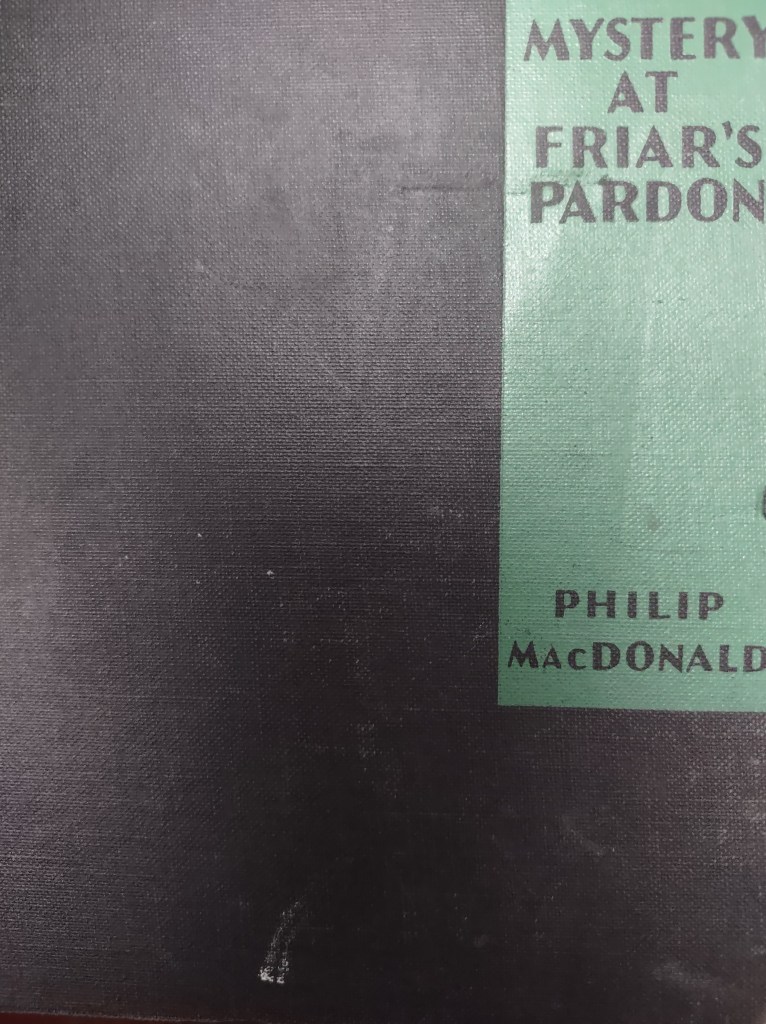
Note for the curious, MacDonald wrote this under the pseudonym Martin Porlock. My copy was published in the US under his real name by The Crime Club, Inc (1932). I’ll be damned if I can find a single image of the US cover.

 James Scott Byrnside
Agreed! I found the drowning bit better than the actual locked room mechanics and something that would have been overall more effective had there been, as you said in your ROT13, one more strand tying the knot. The story is annoyingly lacking in past details. Not even a ghost story to compliment and explain how the place became haunted in the first place. You can see how this would have been a very different locked room mystery in the hands of Carr, Talbot or Halter, but still a good one. Hope it gets reprinted!
LikeLiked by 2 people