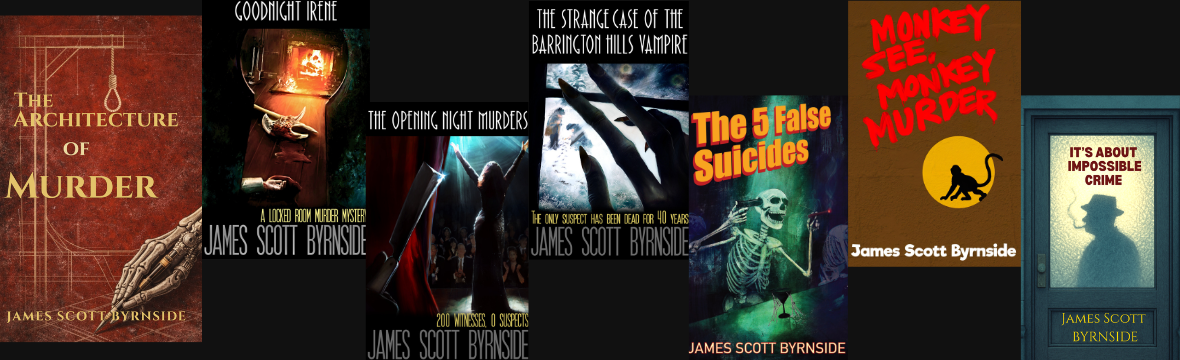


This blog has never been what you’d call “regular.” I’m an author, not a blogger, and the only real reason this thing exists is to share the occasional update or bit of news. Does that help build an audience? Absolutely not.
Every now and then, I’ve also posted a review. And in the short, uneven history of this blog, a few of those reviews have managed to draw the most attention. Here are the ones that topped the charts:
5. The Judas Window — This one is easy to explain. It’s a John Dickson Carr. Moreover, it’s a popular John Dickson Carr.
4. A Ring of Roses — I’d attribute this to 1. a lot of my fans tend to be Brand fans and 2. the obscurity of the book.
3. The Red Death Murders — This makes perfect sense. No other blogger has done more to increase my readership than Jim. His review of Goodnight Irene gave me a readership for the first time. It’s natural that my readers would be fans of his blog and thus interested in his book. If, by chance, you haven’t read his book, you should.
2. Til Death do us Part — This isn’t technically a review but rather a discussion of the locked room murder in that book. Again, we have Carr. If you’re starting a blog and you want to get readers fast, write about Carr. People seem to like him.
1. And the top viewed review on my blog is (drumroll) Murder Mansion! Huh? Don’t get me wrong, I’m glad J.H. Wallis is getting a little traction, but I’m honestly stumped as to why this is my top post. And…it’s not even really close. Murder Mansion has nearly double the views of Til Death do us Part.
I reviewed Wallis’s 1934 novel after hearing about it on the podcast, In Gad we Trust (episode here). Aidan (at Mysteries Ahoy!) nominated Wallis as an author he wanted to see reprinted. I found a cheap copy on Amazon and reviewed it. It was a good, solid mystery.
But why are there so many people interested in Murder Mansion (1934)? And why would they come here to read about it?
I suspect at least half of those people were hoping to read a review of a different Murder Mansion. Perhaps Herman Landon’s 1928 Murder Mansion? If so, there have been a ton of people coming to my site with hope in their hearts to read about Landon’s book. Those people left my site disappointed. And while there’s nothing I love more than disappointing people, there are times one must give the audience what they want.
So—Landon’s Murder Mansion.
The novel follows Donald Chadmore, heir to the Chadmore estate, a looming, tax-burdened mansion in New York. Donald vanished a decade ago, but now he’s back—penniless, looking to reclaim his life, rekindle things with old flame Gloria Westcott, and, inevitably, revisit the mansion. Inside are his hunchback uncle Theodore and eccentric aunt Elizabeth. When they go, the estate is his. And at least one of them is destined not to last long, thanks to the machinations of a shadowy figure named Mr. Staghorn.
At first, the novel leans into pulp adventure—judo chops, faceless voices plotting evil, Donald being tailed by Marx Yarrow, an old enemy recognizable by his missing eyebrows. (Donald once slugged him, earning himself a Wyoming prison stint. Why Yarrow is back in New York years later is anyone’s guess.)
Once Donald returns to the mansion, the book shifts gears. The pulp veneer drops, and suddenly it’s a gothic haunted house tale. The dread comes out of nowhere. One scene has Theodore and Elizabeth standing in the dark, panicking at the play of shadows. We learn that their ancestor Amicus Chadmore was murdered in that very room. He dabbled in the occult, and legend has it he’ll return from the grave to kill again.
And that’s just what he does. In a dark room that is sealed completely, an ugly monstrous face appears (an old mask belonging to Amicus) and an impossible murder is committed. Donald is the only person besides the victim inside the room, even though both men had thoroughly searched the room. Also the piano plays by itself.
The arrival of the police begins the investigation, my favorite part of this book. A character named Doc Locks investigated every inch of the room and is able to rule out any passages, lock tricks, etc. (Side note: introducing a character named Doc Locks for the sole purpose of ruling out all basic jiggery pokery is awesome.) The investigators are great fun. Millikan (police) and Mott (D.A.) get under each other’s skin in wonderful ways. Moreover, the series of questions they pose constantly ignite the plot to movement.
And make no mistake — this book moves. Written in 30 short, punchy chapters — each containing a brand new mysterious element — Murder Mansion doesn’t hold stay in one place for very long. Suspicion is constantly shifted and every seemingly minor character is eventually brought to the fore to be reevaluated in a new light. Sometimes this doesn’t make sense — at one point, Donald takes a few hours to ask one character why he pretended not to recognize Donald in front of the police — but it tends to keep things interesting.
There are demerits. Gloria is a bit insufferable. She is so much the 20s plucky heroine, that she devolves into caricature. It doesn’t help that she insists on calling Donald “Big Boy”. I felt like the solution to the impossiblilty could have been clued a little better. It operates on a fine principle, but doesn’t lend itself to reader investigation. Overall, a bit more rigor would have helped tighten things up.
It was enjoyable, a little better than the Wallis book (the impossibility helped). While the characters aren’t much individually, their functions within the scheme of the plot were well-done. If you find a copy for a cheap price, I’d recommend giving it a go.
So, there you have it. I have now reviewed both Murder Mansions, and no one should ever fear coming to my site in search of a different book with that name. Unless, of course, there is a third Murder Mansion, one whose reputation and rareness are legendary. What are the odds of that? I mean, come on!

 James Scott Byrnside
After seeing Jim over at theinvisibleevent mention this followed by your review, I pulled this from the big pile and just finished it.
I was a bit worried about what kind of book this would be when the first few dozen pages felt more like a thriller or caper story. Fortunately, it settled down into a proper mystery. Like the Wallis novel of the same name (that I enjoyed), the house itself with its unsettling, stuck in time condition was a character in and of itself.
Your review is spot on … a decent impossibility whose solution was reasonable if not fairly clued. I liked the group of “night owl” characters, including Peterkin the keen-eyed valet. And I knew where the diamond would be as the treasure’s location reminded me of a particular Miss Marple story, which had a similar solution.
So while some books almost approach their mythic status such as “Withered Murder” by A&P Shaffer, “Into This Air” by Horatio Winslow & Leslie Quirk, “The Sleeping Bacchus” by Hilary St George Saunders, “Murder Mansion” is more good than great.
LikeLiked by 1 person
I’m sure you already know about the other version of the book, but just in case — the ’28 American edition and the ’30 British edition have different solutions (and, I assume killers). I was going to write a third review as a sort of joke., but I wasn’t able to find the British edition for sale, nor did I find a spoiler for the solution — much better for my dwindling bank account.
Honestly, I think the different culprits speak more to the blandness of some aspects of the novel. The killer could have been anyone — there’s nothing inexorable about the mystery. That said, I am curious about the alternate solution. And I am planning use my own version of the principle of the solution in the American edition. At some point, at least.
LikeLike
Thanks for telling me. I had no idea there was a British edition with another solution. I am curious as well as to what it is.
Of course there are differences at times between the UK and US titles from Agatha Christie, John Dickson Carr, etc., but I can’t think of any GAD titles where the solution changed dramatically.
A quick check of ChatGPT also led to a similar conclusion. If the US and UK versions of books by Queen, Marsh, Berkeley, Bentley, etc. differed slightly, it mainly was the result of the editing by the publishers versus the authors providing different culprits, motives, etc.
LikeLike