

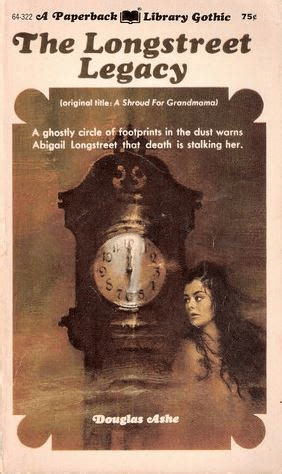
Douglas Ashe’s The Longstreet Legacy is delightful for several ancillary reasons. But let’s get the main things out of the way first. Abigail Longstreet is the youngest granddaughter of an old, blind recluse named Ella Maybelle Longstreet. Ella has been behaving strangely these past few months—firing all her staff, leaving raw meat in the fridge, and throwing secret notes with rings onto the heads of people passing by her home.
That last one is what sets the plot into motion. The victim of said note-throwing is Arthur Crump—just some dude walking by who suddenly becomes interested. He visits Abigail and begs for her help in solving the mystery. Why is dear grandmama throwing things out her window? A visit to the home reveals a far more potent mystery.
Why is dear old grandmama lying dead in the middle of a field of dust? And why are there no footprints leading to her body? And why are there footprints in the middle of the dust going in several different directions—none of which belong to her? And why is she wearing a bikini?
You get the idea.
Later, we find out that all of Abigail’s family (mother, siblings, and in-laws) visited Ella throughout the day. All have motives, and all have something to hide.
Enter Inspector Stephen Eliot, a most entertaining and dramatic fellow. He lies whenever he wants (it’s no big deal; his suspects lie to him—he is returning the favor) and is constantly playing games of confidence and accusation.
The story is broken into two mirrored halves. The first is the interview of the family during the afternoon. The second is the family’s return during the midnight hours—an event caused by the realization that a complete nutjob might be secretly living inside the house.
The mystery’s setup, investigation, and revelation are handled very well, but it’s the small, character details of storytelling that make this book so memorable.
The narrator, Abigail, is decidedly unhip, an old soul stuck in a young body. Several times, she convinces herself that she is not a snob, then proceeds to exhibit grade-A snobbery. The disconnect between her thoughts and actions somehow deepens her character. She tries her best not to fall for Arthur, and we are privy to her emotional confusion.
The false solutions near the end are expertly handled, especially coming from Eliot. Each false layer leaves behind one or two truths, so when the real culprit is named, it carries a lot of weight.
And the book’s just plain funny. Check out these lines:
“The men in the family tell me her legs are good—they are certainly as tanned as any Indian’s.”
“You beast!” I cried. “You transvestite!”
And the book opens and closes with a bit of French: “Honi soit qui mal y pense.” The first time, it’s used as a barb against anyone reading anything into the scandalous murder. The second time, it’s about Abigail getting laid. Thus, sex and death are once again bedfellows.
I have minor complaints (too much backstory comes at the end; there’s frightfully little emotion at the second murder; and the sheer amount of lying sometimes comes across as laziness), but I don’t think you’ll mind too much. The footprints problem is good, but it doesn’t arise organically from the story. It’s a completely separate affair, and its solution doesn’t lead at all to the killer. I like the structure and the characters more.

 James Scott Byrnside
Sounds fun; shall keep an eye out for this — many thanks.
LikeLike
You won’t be bored.
LikeLike