

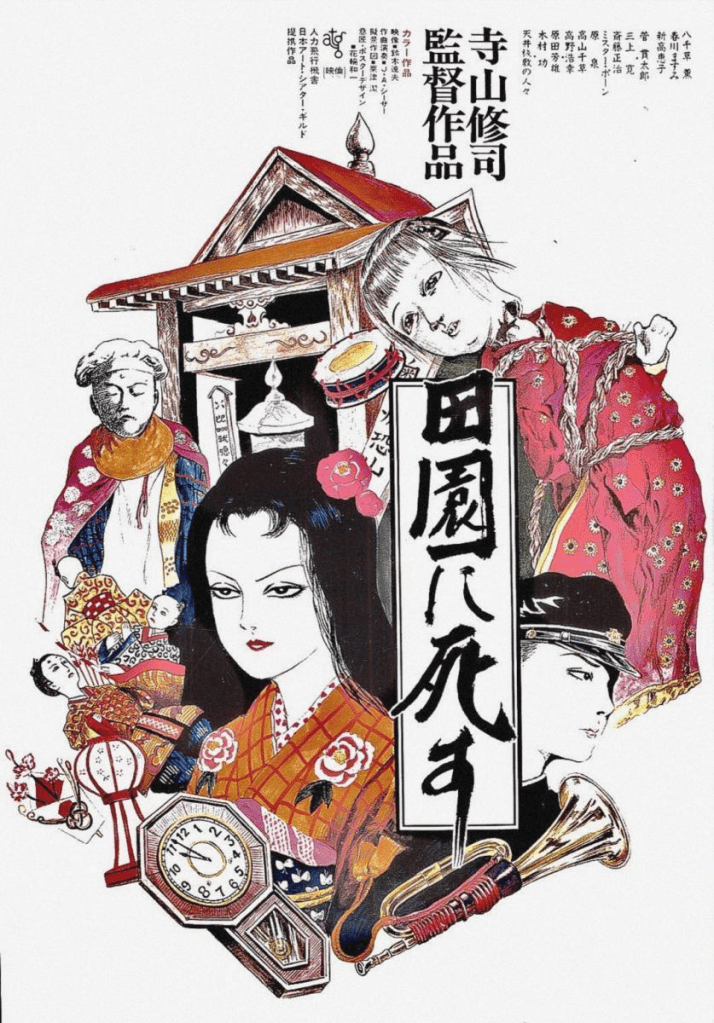
“The more I describe it, the more vague it gets.” — Shūji Terayama, Pastoral: To Die in the Country (1974)
I love this quote, but (perhaps appropriately) the more I think about it, the less specific it gets. Essentially, it’s about the inadequacy of descriptions or labels.
Suppose I ask you what grief feels like.
You might say that it resembles emptiness. But that’s not quite right, is it? So, you elaborate.
“It’s an emptiness, but not exactly emptiness. More like something incredibly important has been removed from the world. It’s almost physical. You can feel it in your chest. But it’s not quite sadness. Sometimes you’re not even sad when you grieve. It’s more that everything seems slightly unreal and you feel like a stranger on Earth.”
By the time you’re done, I may have no clue what grief feels like.
That’s all well and good, but once again, a great idea finds a special place in the realm of detective fiction and impossible crimes. Don’t you know that everything worthwhile relates back to impossible crime?
At the beginning, we have something very simple: a man was murdered in a locked room. We may think we understand the basic situation. But then the detective starts finding more information. The door was locked from the inside. The windows couldn’t have been used. There was no weapon. Someone heard a strange noise. There is a footprint that shouldn’t be there. The clock stopped at the wrong time.
Each new fact gives us more information, but somehow we understand the crime less and less.
The reason is that every new fact destroys one of our possible explanations, or at the very least alters it irrevocably. We start with one simple idea of what happened, and then the evidence keeps telling us that idea can’t be right. So, the mystery becomes more detailed while also becoming more mysterious.
In a good impossible crime, this eventually reverses itself. All those confusing details suddenly fit together, and what seemed impossible becomes completely understandable.
So, there is almost a three-step process: simple → complicated → clear.
The more we try to explain something, the more we sometimes discover that our original understanding was too simple. We aren’t necessarily making the thing itself more vague. We’re discovering that we didn’t understand it as well as we thought we did.
And maybe that’s one of the pleasures of a good mystery: for a while, knowing more makes you understand less. The detective gathers facts, the reader gathers clues, and the mystery only gets deeper. Until, suddenly, all those confusing details fall into place—and you realize that the answer was there all along.


