
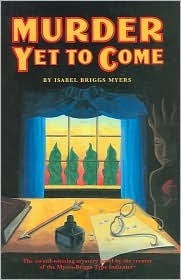
The more I write, the more I appreciate a well-measured novel. No longer am I solely interested in “wow” factors. Puzzles with unfrayed edges bring me more joy than duct-taped shit with a clever solution or two. Isabel Briggs Myers’s Murder Yet to Come is a puzzle that locks together smoothly: a well-filigreed plot, characters whose decisions make sense, and a sure sense of narrative thrust. That last one is very important.
We begin after the main (murderous) events. Our detective is playwright Peter Jenningham. He’s not nearly as obsessed with his own genius as he is with the machinations of cause and effect. His secretary, “Mac,” is the narrator. He’s not a Van Dine-style cipher, but he manages not to dominate the proceedings. Both Jenningham and Mac are emotionally drained after the night’s work investigating the murder of a man named Malachi Trent.
A word of warning. Based on their discussion, you might think you’re in for one of those horror mysteries that take place at an isolated location with lots of things going bump in the night. You know, the kind of thing I like to write. This is not that. MYTC goes all in on detection, and at no point are you as unnerved as the characters.
Jenningham and Mac are joined by Police Sergeant Carl Nilsson for lunch. They overhear a man on the telephone in distress. When they question the man (Ryker), we learn the situation. A hateful old copper baron named Malachi Trent is keeping Ryker’s fiancée (Linda Marshall) prisoner in his home. Ryker wants assistance freeing her.
This is not the greatest setup in the world. It’s true that Nilsson is an off-duty cop, but still, only in 1920s novels do men agree to “free” someone they’ve never met. Thankfully, everything is uphill from here.
The four men rush to the Trent house and hear a loud crash. Malachi Trent appears to have had a terrible fall from the ladder in his library. One door is locked and the other is nailed shut. The only other person in the room is Linda, the woman they came to rescue. Other people in the house include Trent’s grandson (David), his housekeeper (Mrs. Ketchem — really, Isabel?), and servant (Ram Singh).
It looks like everything has worked itself out.
Except for one small problem: Trent was murdered in that locked room, and Linda wasn’t the killer.
From here, things are pure entertainment. One of Myers’s best tricks is introducing elements that seem to prove one thing, only to disprove it. The fact that the nailed door wasn’t locked, for example. Immediately, you might think it wasn’t locked because it was nailed shut. Why lock a nailed door, after all? The opposite turns out to be true. Myers keeps shifting the ground beneath your feet without ever making you feel she’s cheating. Multiple confessions are given with high drama, only to be rejected by Jenningham, much to Nilsson’s consternation.
The title provides the narrative thrust I mentioned earlier. This is not just an investigation into a murder. The specter of the second murder (I’ve talked about this before) lingers in the background. Who else would need to be killed? And why? Then comes the tantalizing revelation, before the flashback:
“Why did you keep it from the police in the first place?” he inquired.
“Because I thought,” Jenningham answered, almost absent-mindedly, “that it was our one chance to prevent the second murder.”
“What?” Collins cried. “You mean you saw it coming?”
“From a long way off,” Jenningham replied. “We didn’t know who the murderer would be, or the victim. But we did know there was murder yet to come.”
Fantastic. I had a great time with this. It’s highly recommended.
Oh, yeah. One other thing. The interviews.
I’ve come to appreciate interviews. Not because they’re always good — indeed, they often suck — but because they’re important for character. In true crime (podcasts or documentaries), interviews are fascinating. Psychologically, they’re incredibly fertile territory. Rarely are the stakes higher than when a suspect’s life depends on the person sitting across the table.
Of course, documentaries and podcasts can give us the final interview, the one where all the sparks fly. There may have been five other interviews that were boring as shit. We never have to sit through those.
Books can’t do that. They have to give you the full monty — dragging the Marsh. That’s why they often end up being so incredibly tedious. As I’ve written more and more, my interviews have improved a lot. There are elements that aren’t so realistic, but that’s the price you pay for making them more entertaining.
The interviews in MYTC are superb. Myers understands that an interview isn’t simply an opportunity to extract information. It’s a dramatic encounter between two people, each with something to gain or lose. I’d encourage you to read this novel if you intend on writing detective fiction. There’s plenty to learn here.


