

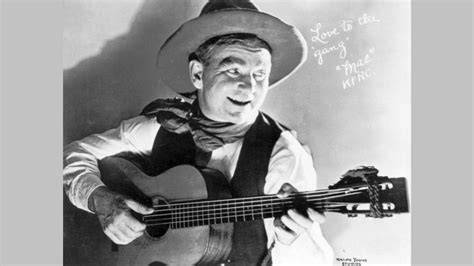
There are songs that seem to arrive from some impossible America that never really existed: railroad tracks vanishing into sunset, hobo camps glowing beside the rails, drifters who answer to nobody and sleep under the stars. Harry McClintock’s Big Rock Candy Mountain belongs to that world. For decades, it has been treated as a charming piece of Americana — funny, whimsical, almost childlike in its imagination.
I loved the song the first time I heard it.
How could you not?
One evening as the sun went down
And the jungle fire was burning
Down the track came a hobo hiking
And he said, Boys, I’m not turning
Immediately, the song opens a door into fantasy. The hobo is not exhausted or hungry. He is a kind of wandering prophet, a salesman for paradise:
I’m headed for a land that’s far away
Besides the crystal fountains
So come with me, we’ll go and see
The big rock candy mountain
And then the song gives us one of the most unforgettable landscapes in American folk music. The imagery piles up in delirious, lyrical waves.
In the big rock candy mountain
There’s a land that’s fair and bright
Where the handouts grow on bushes
And you sleep out every night
Where the boxcars all are empty
And the sun shines every day
Oh, the birds and the bees
And the cigarette trees
The lemonade springs
Where the bluebird sings
In the big rock candy mountain
Everything is inverted into abundance. Nature itself becomes generous. Trees grow cigarettes. Springs run with lemonade. The cops are harmless and labor is obsolete.
In the big rock candy mountain
All the cops have wooden legs
And the bulldogs all have rubber teeth
And the hens lay soft-boiled eggs
The farmers’ trees are full of fruit
And the barns are full of hay
Oh, I’m bound to go
Where there ain’t no snow
Where the rain don’t fall
The winds don’t blow
In the big rock candy mountain
The fantasy becomes even more indulgent.
In the big rock candy mountain
You never change your socks
And the little streams of alcohol
Come trickling down the rocks
There’s a lake of stew and of whiskey too
You can paddle all around it in a big canoe
In the big rock candy mountain
And finally:
In the Big Rock Candy Mountains
The jails are made of tin
And you can walk right out again
As soon as you are in
There ain’t no short-handled shovels
No axes, saws, or picks
I’m a-going to stay where you sleep all day
Where they hung the Turk that invented work
In the Big Rock Candy Mountains
I’ll see you all this coming fall
In the Big Rock Candy Mountains
It is almost impossible not to be seduced by the song. It sounds carefree and liberating—freedom stripped of consequences. Even the roughness of hobo life becomes romantic. The song takes poverty and transforms it into a fairy tale. And all respect to Harry Mcclintock’s abilities as a singer to wrap it folksy charm.
An older variant called The Appleknocker’s Lament reveals the song’s original purpose. Understand, in no way do I think I’m uncovering something unknown. Every folk scholar on earth loves pointing out that old stories used to be dark. That has practically become its own cliché. No — what shocked me was realizing that the modern version had not simply softened the original. It had accidentally reversed its meaning cmpletely.
The Appleknocker’s Lament begins similarly enough:
On a very fine day in the month of May
A great big bum came hiking
Again, we meet the wandering drifter. Again, he encounters a boy.
On the very same day in the month of May
A farmer’s lad came hiking.
Said the bum to the son, If you will come,
I’ll show you some sights to your liking.
And then the promises begin.
The exact same promises.
I’ll show you the bees in the cigarette trees,
The big rock candy mountains,
The chocolate heights where they give away kites
And the sody-water fountains.
The resemblance is unmistakable. The imagery that later became whimsical Americana is already here. But now it functions differently. In Big Rock Candy Mountain, the fantasy is presented sincerely. In The Appleknocker’s Lament, it is bait.
The lemonade springs where the bluebird sings,
The marbles made of crystal.
We’ll join the band of Dangerous Dan
Who carries a sword and a pistol.
The boy follows him. I mean, what young boy wouldn’t want to hang out with Dangerous Dan?
Then comes the passage of time.
So the bum set out with the lad at his back.
For six long months they travelled,
Then the boy came back on the very same track
And this sad tale unravelled.
What follows is devastating.
There are no bees in the cigarette trees,
No big rock candy mountains,
No chocolate heights where they give away kites,
Or sody-water fountains.
Every lyrical image carries new meaning. The fantasy itself becomes evidence of deception. The child is not reminiscing about paradise. He is repeating the lies he was told.
No lemonade springs where the bluebird sings,
No marble made of crystal.
There is no such man as Dangerous Dan
Who carries a sword and a pistol.
What follows is even worse.
He made me beg and sit on his peg
And he called me his jocker.
When I didn’t get pies he blacked my eyes
And called me his apple-knocker.
No more I’ll roam from my very fine home.
I’ll save my junkerino.
You can bet your lid that this old kid
Won’t be no one else’s punkerino.
Even in cleaned-up printed versions, the implications are horrifyingly obvious. The song is about exploitation, abuse, and the predatory underside of transient railroad culture. Vulnerable boys were lured away with fantasies of freedom and abundance and then brutalized.
Once you hear this version, the modern Big Rock Candy Mountain becomes impossible to hear the same way again.
Because the sanitization did not merely remove vulgarity.
It removed the warning.
The modern version preserves:
- the temptation,
- the fantasy,
- the seduction,
- the smiling drifter promising paradise beside the railroad tracks.
But it removes:
- the deception,
- the exploitation,
- the consequence,
- the child returning home broken.
In other words, the cleaned-up version accidentally keeps the predator’s sales pitch while deleting the victim’s testimony. It would be like writing a song about a nice man with candy in his van.
And this is what infuriates me about the sanitization of folk songs and fairy tales. People defend these changes as though they make stories gentler or healthier, but often they simply make them emptier — or worse, more dishonest.
The original folk material had purpose. These stories emerged from dangerous worlds and carried practical warnings inside them. The old stories were brutal because reality was brutal. Reality is brutal.
Modern culture often strips away everything uncomfortable while leaving behind the glittering surface. We preserve the candy house but remove the witch. We preserve the seduction but erase the danger. We keep the dream and destroy the meaning.
And once you notice this process, you see it everywhere.
It sucks.
And maybe this is why so much modern culture feels spiritually weightless to me. We inherit stories stripped of danger, stripped of ambiguity, stripped of anything that might genuinely disturb us. The result is art that is safer but somehow less honest. We preserve the fantasy while amputating the truth that gave the fantasy meaning in the first place.
I’ve said before that I often set stories in the past because I don’t want modern forensics ruining a perfectly good impossible crime. But I think there’s another reason too: I do not trust modernity’s view of itself.
Modern culture constantly congratulates itself for being more enlightened than the past. We sanitize old stories as though we are improving them morally. We shave away cruelty, exploitation, danger, ambiguity. But much of the suffering itself never disappeared — it merely became easier not to see.
There is more slavery in the world now than at any other point in human history — https://www.walkfree.org/global-slavery-index/ , yet most people can go entire days without thinking about it once. We live surrounded by invisible suffering while imagining ourselves uniquely compassionate.
We romanticize the past when it flatters us and demonize it when it doesn’t. Either way, we flatten it into caricature. Fellini understood this when he made Fellini Satyricon — which you can watch HERE. The ancient world in that film feels alien because the past was alien. We cannot truly understand it because we can only look backward with modern eyes.
In a hundred years, people will misunderstand us just as badly.
Even the roots of Big Rock Candy Mountain go back centuries before American railroads. One of its ancestors, the seventeenth-century Invitation to Lubberland, describes another impossible paradise:
The rivers run with claret fine,
The brooks with rich canary,
The ponds with other sorts of wine,
To make your hearts full merry
And:
The fountains flow with brandy,
The rocks are like refined gold,
The hills are sugar candy.
The fantasy barely changed across hundreds of years:
- endless food,
- endless drink,
- endless pleasure,
- freedom from labor,
- freedom from consequence.
But older stories often understood that fantasies are dangerous precisely because they are seductive.
That understanding has largely vanished from modern retellings. What survives is nostalgia — polished, marketable nostalgia. The rough edges are sanded away until the stories become emotionally safe and spiritually vacant. Perfect for modern times.
And yet traces of the old meanings survive anyway. That is why Big Rock Candy Mountain still feels slightly uncanny even in its cleaned-up form. The imagery is too desperate to persuade. It remains a predator’s sales pitch.
Beneath the cheerful Americana, you can still hear the ghost of the older song.
You can still hear the boy coming home at last and saying:
“There are no bees in the cigarette trees…”


